Friday, May 18, 2012

Schola; June Schedule

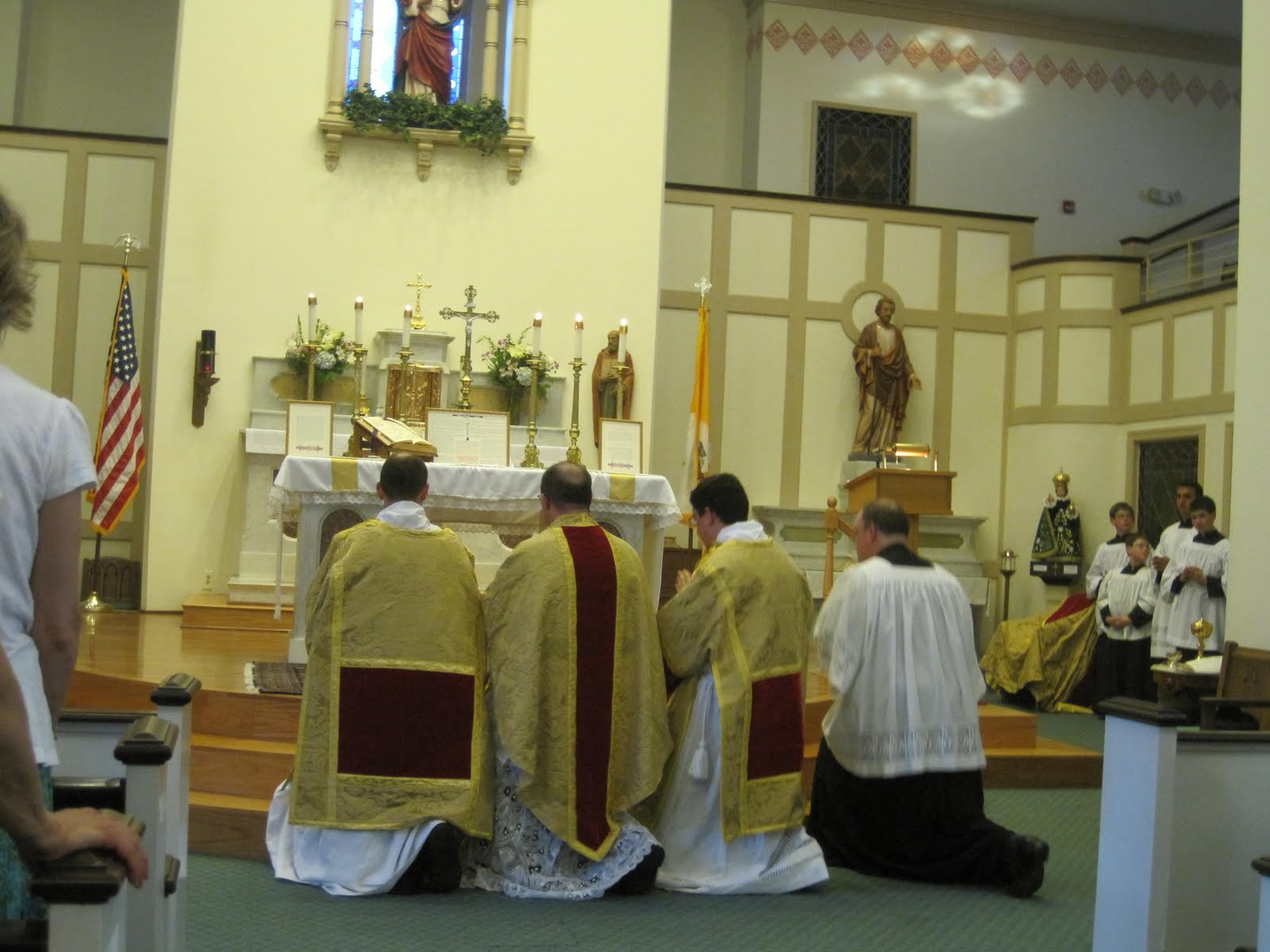
Missa Cantata for Corpus Christi at St. Will
June 7, 7AM (warm-up at 6:30 AM)

Propers
 Cibavit eos(Introit)
 Oculi Omnium (Gradual ) 
 Caro Mea (Alleluia)
 Lauda Sion (Sequence)
 Sacerdotes Domini(Offertory, women)
 Quotiescumque Manducabitis (communio)

Ordinary parts
Mass setting VIII, Credo VI

Motet after Offertory:  Ave Verum (Byrd)
Hymn after Communion: Adoro te Devote


At OLPH
Saturday Mass (8:15AM) (Warm - up at 7:40)
June 2, 16

Kyrie VIII
Alleluia.
Sanctus XVIII
Mysterium Fidei and Amen
Agnus Dei XVIII
 Hoc Corpus
SEP
Salve Regina

At Resurrection Church
Saturday Mass (9AM) (Warm-up starts at 8:30)
June 9, 23

Kyrie VIII
Alleluia
Sanctus XVIII
Mysterium Fidei and Amen
Agnus Dei XVIII
Hoc Corpus
SEP
Salve Regina


Children's Schola

First Friday Mass at OLPH

Wednesday, May 2, 2012

Schola: May Calendar

Missa Cantata for Ascension Thursday at St. Will
May 17, 7AM (warm-up at 6:30 AM)

Propers
Viri Galilaei (Introit)
Ascendit Deus (Alleluia, women, verse) 
Dominus In Sina (Alleluia):
Ascendit Deus (Offertory, women)
Psallite Domino (communio)

Ordinary parts
Mass setting I, Credo VI
Motet after Offertory: Cantate Domino
Hymn after Communion: Salutis Humanae Sator


At OLPH
Saturday Mass (8:15AM) (Warm - up at 7:40)
May 5, 19

Kyrie I
Gospel Accl.
Sanctus XVIII
Mysterium Fidei and Amen
Agnus Dei XVIII
Magnificat Anima Mea
Salve Mater
Regina Caeli

At Resurrection Church
Saturday Mass (9AM) (Warm-up starts at 8:30)
May 12, 26

Kyrie I
Gospel Accl.
Sanctus XVIII
Mysterium Fidei and Amen
Agnus Dei XVIII
Magnificat Anima Mea
Salve Mater
Regina Caeli


Children's Schola

First Friday Mass at OLPH

Monday, April 2, 2012

Schola: April calendar

Missa Cantata for Easter Thursday at St. Will
April 12, 8AM (warm-up at 7:30 AM)

Introit: Victricem Manum
Gradual: Haec Dies
Alleluia: Surrexit Christus
Sequence: Victimae Paschalis Laudes
Offertory: In Die Solemnitatis
Communio: Populus Acquisitionis
Recessional: Regina Caeli


Mass setting I, Credo I
Hymns after Offertory: O filii et filius
after Communion: Lapis Revolutus est


At OLPH
Saturday Mass (8:15AM) (Warm - up at 7:40)
April 21

Kyrie I
Gospel Accl.
Sanctus XVIII
Mysterium Fidei and Amen
Agnus Dei XVIII
Pascha Notrum
Regina Caeli

At Resurrection Church
Satruday Mass (9AM) (Warm-up starts at 8:30)
April 14, 28

Kyrie I
Gospel Accl.
Sanctus XVIII
Mysterium Fidei and Amen
Agnus Dei XVIII
Populus Acquisitionis (4/14)
Pascha Notrum (4/28)
Regina Caeli


Children's Schola


Wednesday Mass at St. Paul

April 11, 18, 25, 8AM

Kyrie XVI
Gospel Accl.
Sanctus XVIII
Mysterium Fidei and Amen
Agnus Dei XVIII
Communion chant

Posted by miacoyne at 11:40 AM

Sunday, March 25, 2012

Dear Et Lux Ensemble:

http://www.musicasacra.com/forum/discussion/6296/modern-tenebrae-et-lux-in-tenebris-by-koerber#Item_29

Dear Et Lux Ensemble:

Congratulations on getting thrown into the deep waters of last nights rehearsal and not drowning. I purposely brought the strings and organ in early (relatively speaking to our overall progress) and put you in your actual performing space so you could get your 'musical sea legs' on this one. Allow me just a couple of minutes to elaborate.

Vocalists, I know you are still not over the initial hill of "getting the notes" inside of you, and I am not the least bit surprised, although I was a bit eager for you to have progressed further than where we have arrived up to this point in time. But this is a tall order. Don't be discouraged or alarmed.

My particular style of composing these choral/orchestral polyphonic textures, (and a great deal of my compositional output over the course of my career) puts great demands on the vocalists, and in particular, the gyroscope of their harmonic balance -- independent of instrumental support. As one of my vocalists reminded me last night, 'you give us no cues'. The truth is, the cues are all there in the harmonic structure itself, but I am not allowing you the extravagance of a (doubling) instrument as a crutch to help you walk. You, my dear singers, will have to walk on your own! Yes, it is a challenge, but well worth it in the final performance. It does require a certain resolute and discipline to learning the score on your own, I will admit. But the most beautiful choral essence of your voices must and will arrive in its own space to shine in the beauty of its own nakedness, unclothed in the timbres of strings or pipes.

I must at this point laud and thank Mr. Viola, who has spent decades of hours learning this work, as he (and his vocal teacher with whom he has rehearsed over the last month) realized the nature and difficulty of it from the get go. Some others of you have had the opportunity of more time to do so, some haven't. It is all the more a challenge in your situations. Thank you for trying your best!

This music is nothing like most other choral works in that it requires you to sing your part "a cappella" while at the same time finding yourself enveloped within a sphere of orchestral sound, which in itself, offers its own unique beauty through its entirely independent musical thoughts and ideas. The marriage of the two bodies of musicians (choralists and instrumentalists) results in something incredible to me, and I hope, to all who hear this music.

As a composer, in particular a composer of sacred music in the Roman Catholic tradition, I raise the importance of the choral element to a level that is not only equal in strength to the instrumental element, but rides above it like a skilled surfer on a great wave. Even the best often go under. The feat of this music is in watching (hearing) the two bodies collaborate and coexist in that moment when the wave (instrumental body) is most powerful and the surfer (vocal body) successfully rides it in to the shore. Each in themself contain an indespensable element that when the wave emerges from the sea and surfer is fit and willing to take the dare, the aural spectacle becomes an incredible experience for both the athelete and the observer. A third entity emerges, one that is entirely spiritual, invisible and ethereal and obviously detectable, but only in the artful and skillful dance of the music.

Choralists and instrumentalists rarely if ever, share the common force of melodic form (at least not at the same time) in this work; instrument and voice do not double any particular melodic line. You each have your own melody and rhythm in each and every part, purposely at odds (or more positively expressed, in contrast) with each other in these regards, so that where the surf board touches the water, a miraculous exhibition of the independent harmonic sphere becomes refulgent. (In this work, the term 'refulgent' is particularly apropos, as it means 'filled with light'.)

In my compositions, vocalists are not an addendum to the instrumental parts. And instruments are not just there to support the vocal line. Everyone is on their own, and at the same time, much more dependent upon the other. If this can help your thinking, it is almost like a weave of solos, all happening at once, giving and taking, cautiously stepping and progressing, like some kind of grand dance.

As vocalists, you have an extra responsibility, to carry and deliver the power of the message, most pointedly, the words. I will recount what I hear often from some, from those in our congregation here, and in various forums where musicians lurk. "Why not English?" There are numerous reasons to that question. For one, in the Latin, the words simply become timeless and universal, rising above geographic, cultural and novel influence and political correctness. Secondly, the structure of Latin allows for the easy reversal of subject and verb, for dividing meanings into simple short phrases, and it is a speaking-friendly language. It simply sounds beautiful in music. English, in my opinion as a professional vocal composer, is heavy, cumbersome and of course, guttural. I have composed a lot of music in English. It's not pretty for choral music. Thirdly, look at the reams of choral music from other great composers. Even Bach, a staunch Lutheran, whose music was mostly in his native tongue (and guttural), thought to announce one of his greatest works in Latin, his B Minor Mass. This makes it all the more challenging for the vocalists. Thanks for your extra effort!

So this is why I send you (vocalists) CD discs, require and offer myself to you for extra rehearsals, and even one-on-one sessions. I know the demand I have placed on you. I am asking that you "know" the music to your core.

Thank you for your time and effort. The little I can offer in financial remuneration will never repay you for the time you have taken to learn this piece, and for what you will unfold on Good Friday April 6 in the unveiling of Et Lux In Tenebris to the world. I hope and pray you also share in the wealth of that experience and that it will be with you and change you forever.

Most Sincerely Yours in JMJ,

Francis Koerber
Composer, Organist and Choirmaster
(and father of Et Lux In Tenebris)

ph: 307-200-6037
francis@RomanCatholicSacredMusic.com

(the emphasis is mine)

Friday, March 23, 2012

The Beauty of Nine fold Kyrie... is it lost in Novus Ordo?

These days many Catholics don't get to experience the beauty of nine fold Kyrie and appreciate it on most Sunday Masses. When Kyrie is sung after the absolution, it seems to have more distinctive role and form as an Ordinary part, like Sanctus, Agnus Dei.

After I learned to sing Gregorian chant, I discovered nine fold Kyire. (since my parish never did it.) I taught it to my children's schola, and they have been singing nine fold Kyrie for last four years. I explained to them about how we take time to ask for His mercy, especially before we receive our Lord in the Holy Eucharist, as well as about nine choirs of Angels. Although the children were somewhat confused at the beginning, like anything new, they learned that they have to be actually alert and engaged in singing it nine times (alternating between boys and girls.) And now they get very disappointed if we have to sing only 6 fold.

Although in the early church when the liturgy is not yet organized and many things were going through various changes and tried out, chanting Kyrie in the traditional Mass of the Roman rite that we have inherited is done in nine fold. Maybe nine fold Kyrie helps us to remember that we cling on to God's mercy and its beauty, especially in time where 'the sense of sin' has been lost and depending on God's mercy.

Since the new GIRM seems to encourage nine fold Kyrie more than before, maybe parishes can do 6 fold during Ordinary time and progamm nine fold Kyrie at least during Lent and Advent, (since Gloria is not sung during those seasons, the extended time may not be the issue. And since we do extra good things during Lent, and it is encouraged to continue them even after the Lent, the spirit of nine fold can be carried to 6 fold in Ordinary time and appreciated it in a deeper manner.), and have polyphonic settings for major feast days?

Friday, February 24, 2012

Some resources on' brick by brick' approach for the Holy Father's "Reform of the Reform' in Sacrded music and the Liturgy

One of my schola member asked me recently how a diocese can help to bring more sacred music to parishes in this area.

I wrote,
first, mandate Missal chants that US Bishops put out in English in every parish at least for a year. Many dioceses are doing it. They are in their website, both recordings and scores.
Those are the exact same melodies of the "Jubilate Deo" setting for Ordinary parts that Pope Paul VI set aside after the Vatican II. They are the simpest Latin settings that the Church and the Pope desire all the Catholics learn to sing.

"Steps should be taken so that the faithful may also be able to say or to sing together in Latin those parts of the Ordinary of the Mass which pertain to them." (Section 54, the Second Vatican Council, in its Constitution on the Sacred Liturgy)


The Missal chants in English are the first step towards singing the Latin chants, as in the Church's instruction above. (not just in Lent but in Ordinary times)

Next step is having Propers sung by choirs, cantors, intead of random hymns, (or in addition to hymns, if it not possible to have just Porpers). In English first, starting with one Proper such as Communio.(and then have a communion hymn.)

And the next step is offering workshops to help the priest to chant their parts, starting with something they can do well, like Doxology, Preface dialogue (the one that Fr. Warren sings at the Res. church.) If the pastors and priests want the congregation sing, they need to lead them by example by singing their parts in Holy Mass, so the congregations can reply in singing their parts, so that the congreagation become confident in singing by starting with easy parts.

There are dedicated musicians and priests who give workshops and train them to sing chants, such as

Fr. Columba Kelly
http://www.chantcafe.com/2012/01/restoration-of-propers-of-mass-chant.html

Fr. Johansen
http://www.chantcafe.com/2012/01/traveling-chant-workshop-on-chants-of.html

Fr. Mark Kirby.
http://vultus.stblogs.org/

There are so many chant workshops everywhere these days.
And she should also attend Colloquium to experience beautiful and authentic liturgy.

It is a long time process, but read and learn more tradition to understand and intepret the Church's recent documents. Without knowledge of the Catholic Tradition, readers will be confused on interpreting GIRM, because it is based on previous documents and the tradition. The recent documents assume that people who reads them know the tradition and don't mention everything.

Especially the following two documents are very important.
Motu Proprio: Tra Le Sollecitudini (1903)
Musicam Sacram (1967)

There are many posted in musicasacra.com.

http://musicasacra.com/literature/
(under Church documents.)

Also there are so many books, such as

The Spirit of the Liturgy by Cardinal Ratzinger,
A New Song for The Lord by Peope Benedict XVI
The Musical Shape of the Liturgy By Dr. Marht
http://www.chantcafe.com/2012/01/treatise-weve-needed.html

Thursday, February 23, 2012

Schoal: March Calendar

At OLPH
Saturday Mass (8:15AM) (Warm - up at 7:40)
March 3, 17, 31

Kyrie XVII
Gospel Accl.
Sanctus XVIII
Mysterium Fidei and Amen
Agnus Dei XVIII
Ubi Caritas (3/3)
Stabat Mater (3/17)
Adoramus Te Christe (3/31)
Ave Regina Caelorum


At Resurrection Church
Satruday Mass (9AM) (Warm-up starts at 8:30)
March 10, 24

Kyrie XVII
Gospel Accl.
Sanctus XVIII
Mysterium Fidei and Amen
Agnus Dei XVIII
Parce Domine (3/10)
Jesu Dulcis (3/24)
Ave Regina Caelorum


Stations at the church of Resurrection
March 16, 7 PM

Stabat Mater
Attende Domine


Holy Hour and Benediction at St. Benedict
March 24 at 5 PM

1. Anima Christi (Children sing; during Preparation of the Holy Hour)

2. O Salutaris Hostia (everyone)

Prayer

3. Adoro te devote (children and men)
4. O Panis Dulcissime (children)
5. Ave verum Corpus (children)
6. Jesu Dulcis Memoria (Adults)

Scripture Reading: 1 Samuel 3:8 – 10

7. Veni Creator Spiritus (children)
8. Ubi caritas (adults & children)
9. Adoramus te Christe (Adults)

Prayer for Vocations

10. Salve Regina (Solemn tone, Adults)
11. Ave Regina caelorum (men)

Scripture Reading: Matthew 4:18 - 22

12. Ave Maria (Mode VI, children)
13. Ave Maria (Mode I, children)
14. Immutemur Habitu (adult)

Benediction

15. Tantum Ergo (everyone)

Priest: Panem de caelo praestitisti eis
Response (all): Omne delectamentum in se habentem

Prayer (priest)

Divine Praises (chanted by cantor/everyone.
Music and words are at the end of this packet.)

Final chant (schola)
16. Christus vincit


Children's Schola

First Friday Mass at OLPH
March 2, 8:15 AM (warm up starts at 7:45 AM)

Kyrie VIII
Gospel Accl.
Offertory: Attende Domine
Sanctus XVIII
Mysterium Fidei and Amen
Agnus Dei XVIII
Communion: O Panis Dulcissime
O Salutaris Hostia (Benediction)


Wednesday Mass at St. Paul
March 7, 14, 21, 28, 8AM

Kyrie XVI
Gospel Accl.
Sanctus XVIII
Mysterium Fidei and Amen
Agnus Dei XVIII
Communion chant