Sunday, November 3, 2013
Schola: November
Third Tuesday Mass at the Our Lady's Center
Nov. 19, at 6:30 PM
Propers
Introit: Cognovi Domine
Gradual: Diffusa Est Gratia
Alleluia: Specia Tua
Offertory: Diffusa Est Gratia
Communion: Dilexisti Justitiam
Ordinary Parts
Mass Setting IX
Hymns
Magnificat, Adoremus in Aeternum
Second Thursday Mass at St. Paul (children)
Nov. 14, 8 AM (Warm-up starts at 7:45 AM)

Sunday, September 22, 2013
Children's Schola: Oct. Schedule
First Friday Mass at OLPH
Oct. 4, 8:15 AM (Warm-up starts at 7:45 AM)
Oct. 4, 8:15 AM (Warm-up starts at 7:45 AM)
Schola: Oct. Schedule
Aufer a Me (19 - 28th Sunday, Gregoran Communio)
http://media.musicasacra.com/books/communio_english.pdf
Domine, Dominus Noster (26 - 29th Sunday, Communio in English from SEP)
Domine, Dominus Noster (26 - 29th Sunday, Communio in English from SEP)
Salve Regina
Sunday, September 1, 2013
Wednesday, June 12, 2013
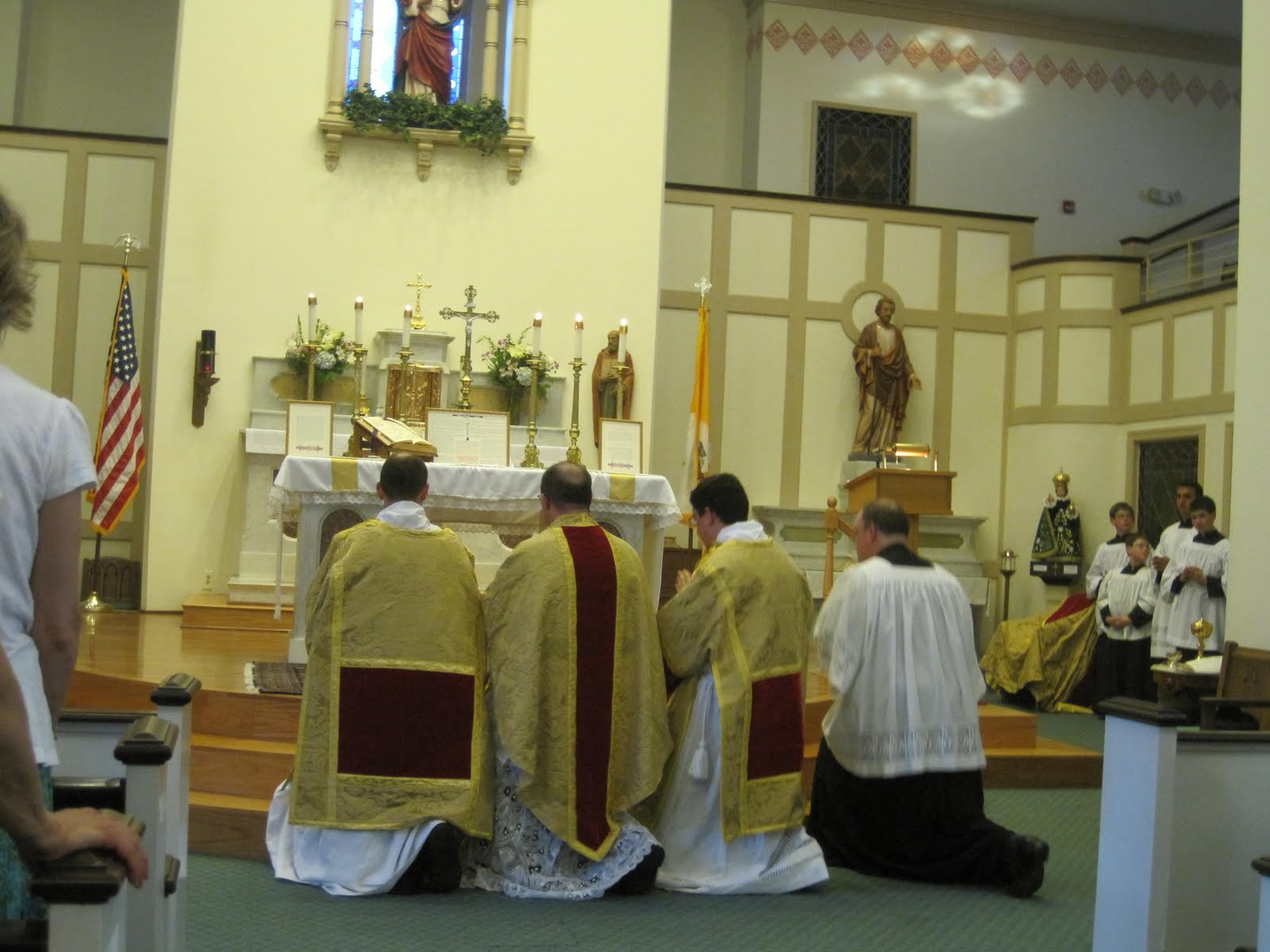
Solemn High Mass for the Feast of Corpus Christi
http://www.newliturgicalmovement.org/2013/06/corpus-christi-2013-ellicott-city.html
Solemn High Mass for the Feast of Corpus Christi was celebrated according to the Extraordinary Form on Thursday, May 30 at St. Paul's Church in Ellicott City, Maryland.
The Mass was followed by a procession through the grounds of the church, concluding with Benediction of the Blessed Sacrament.
Sunday, April 28, 2013
First Friday Mass for May and June
First Friday Mass at OLPH
May3, 8:15 AM (Warm-up starts at 7:45 AM)
May3, 8:15 AM (Warm-up starts at 7:45 AM)
Monday, April 8, 2013
chant is the perfect musical expression of Pope Francis’s vision of humility
James MacMillan says chant is the perfect musical expression of Pope Francis’s vision of humility
The new papacy of Francis has brought great joy and renewal to the Church and a huge wave of good will from non-Catholics. What will this new Pope bring to our sacred liturgies, which are the beating heart of the Church’s philosophy of love?
Baroness Warsi, the Minister for Faith and Communities, attended the papal inauguration Mass in Rome and spoke of the way that Pope Francis’s simplicity resonates with people and singled out “his concept of humility, simplicity and going back to values”.
What does a “poor and simple Church” need in its divine praises? Is there humility in the Americanised, over-the-top, sub-Broadway pop music, dripping with sentimentality, that now infests so much of our liturgy? [No.] Is there simplicity in the here-am-I-Lord egotism of so many of our dreadful modern hymns? [No.] How does the upholstered, fatuous and banal secularity of so much of Catholic contemporary “praise music” succeed in “going back to values”? [It doesn't.]
The dawning of a more austere period in the Church’s mission requires liturgical music of a more austere and simple design: a music that humbly deflects attention from “the music ministry”, a music that is based in Catholic heritage and values, and a music that sounds both Catholic and sacred. The good news is that we have this already, and it is the music that Pope Benedict has been urging us to rediscover over the last decade: chant. [Singing Francis Through Benedict.]
Music for a sacred ritual needs to project sacredness. In the liturgy “sacred” means “the glorification of God and the sanctification of the faithful”. Gregorian chant gives an elevated tone of voice to the texts of our sacred praises, conveying the special character of the words and of the specific holy nature of what is being enacted and undertaken.
The chanting of the holy texts raises them up from the mundane and presents them “as on a platter of gold”, in the words of the Jesuit liturgist Fr Josef Jungmann. Gregorian chant is unlike anything from the everyday world but conveys the clear impression that there is something uniquely holy in the actions of the liturgy. Gregorian chant is holy. [As I picked up from the late Msgr. Schuler, sacred music must be sacred and it must be art. It must be artistically written and performed, but it must have both a sacred text and a sacred idiom. Gregorian chant is perfect in those criteria.]
Gregorian chant is universal as it is supra-national and thus accessible to those of any and every culture equally. It rises above those musics which are either associated only with localised cultural experience, on the one hand, and operates separately from those other musics which are associated with high, artistic, classical derivation and aspiration, on the other. Therefore, it is essentially anti-elitist and simultaneously pure. Gregorian chant is for all.
The beauty of music is a crucial element in the “edification and sanctification of the faithful”. Beauty is the glue which binds together Truth and Goodness. To paraphrase the Swiss theologian Hans Urs von Balthasar, without beauty, truth does not persuade and goodness does not compel. The general function of music in the liturgy is to draw together a diverse succession of actions into a coherent whole. [Not just draw them together, but draw them together in prayer raised to God. Enough of "Gather Us In"!] That is what makes Gregorian chant beautiful.
The Gregorian sound, and the practice of chanting, whether by specialist or non-specialist, gives the most perfect context for the hearing of the words of the Sacred Scripture. It provides an elevated tone of voice that takes the texts out of the everyday and confirms them as sacred.
It provides a goodness of form, which is in itself beautiful, which in turn adds a sense of delight to prayer. It takes our divine praises into the realm of the transcendent and the eternal, and it is the music’s sacred character which enables this.
There is a melodic and rhythmic freedom in chant which is hard to find in any other music. Chant not only enhances the text, but it also breaks free from the restraints of metre. It is the antithesis of rock and pop with its incessant and insistently mind-numbing beat. It embodies the ethereal and spiritual aspects of the liturgy. It is the freest form of music.
The Church would stop being the Church without its liturgy. The liturgy is the pinnacle and summit of our entire Christian life. It has to be of our highest and best, whatever the circumstances. Our liturgical music has to be more than mere utility music. Before he was Pope, Joseph Ratzinger said: “A Church which only makes use of ‘utility’ music has fallen for what is, in fact, useless … for her mission is a far higher one. As the Old Testament speaks of the Temple, the Church is to be the place of ‘glory’, and as such, too, the place where mankind’s cry of distress is brought to the ear of God. The Church must not settle down with what is merely comfortable and serviceable at the parish level. She must arouse the voice of the cosmos and, by glorifying the Creator, elicit the glory of the cosmos itself, making it also glorious, beautiful, habitable, and beloved.”
He went on to say: “The other arts, architecture, painting, vestments, and the arts of movement each contribute to and support the beauty of the liturgy, but still the art of music is greater even than that of any other art, because it forms a necessary or integral part of the solemn liturgy, because it is so intimately bound to the sacred action, defining and differentiating the various parts in character, motion, and importance.”
The new papacy is a welcome opportunity for us to renew and revitalise our attempts at maintaining and continuing the sacred dimension of our liturgical celebrations. Let us follow Pope Francis’s example in being humble, in being simple, and in rediscovering our basic core Catholic values.
James MacMillan is a leading composer. Musica Sacra Scotland, a new national advisory group for music and the liturgy in Scotland, is planning a one-day conference with helpful, practical workshops in November. Full details will be released nearer the time
From here
The new papacy of Francis has brought great joy and renewal to the Church and a huge wave of good will from non-Catholics. What will this new Pope bring to our sacred liturgies, which are the beating heart of the Church’s philosophy of love?
Baroness Warsi, the Minister for Faith and Communities, attended the papal inauguration Mass in Rome and spoke of the way that Pope Francis’s simplicity resonates with people and singled out “his concept of humility, simplicity and going back to values”.
What does a “poor and simple Church” need in its divine praises? Is there humility in the Americanised, over-the-top, sub-Broadway pop music, dripping with sentimentality, that now infests so much of our liturgy? [No.] Is there simplicity in the here-am-I-Lord egotism of so many of our dreadful modern hymns? [No.] How does the upholstered, fatuous and banal secularity of so much of Catholic contemporary “praise music” succeed in “going back to values”? [It doesn't.]
The dawning of a more austere period in the Church’s mission requires liturgical music of a more austere and simple design: a music that humbly deflects attention from “the music ministry”, a music that is based in Catholic heritage and values, and a music that sounds both Catholic and sacred. The good news is that we have this already, and it is the music that Pope Benedict has been urging us to rediscover over the last decade: chant. [Singing Francis Through Benedict.]
Music for a sacred ritual needs to project sacredness. In the liturgy “sacred” means “the glorification of God and the sanctification of the faithful”. Gregorian chant gives an elevated tone of voice to the texts of our sacred praises, conveying the special character of the words and of the specific holy nature of what is being enacted and undertaken.
The chanting of the holy texts raises them up from the mundane and presents them “as on a platter of gold”, in the words of the Jesuit liturgist Fr Josef Jungmann. Gregorian chant is unlike anything from the everyday world but conveys the clear impression that there is something uniquely holy in the actions of the liturgy. Gregorian chant is holy. [As I picked up from the late Msgr. Schuler, sacred music must be sacred and it must be art. It must be artistically written and performed, but it must have both a sacred text and a sacred idiom. Gregorian chant is perfect in those criteria.]
Gregorian chant is universal as it is supra-national and thus accessible to those of any and every culture equally. It rises above those musics which are either associated only with localised cultural experience, on the one hand, and operates separately from those other musics which are associated with high, artistic, classical derivation and aspiration, on the other. Therefore, it is essentially anti-elitist and simultaneously pure. Gregorian chant is for all.
The beauty of music is a crucial element in the “edification and sanctification of the faithful”. Beauty is the glue which binds together Truth and Goodness. To paraphrase the Swiss theologian Hans Urs von Balthasar, without beauty, truth does not persuade and goodness does not compel. The general function of music in the liturgy is to draw together a diverse succession of actions into a coherent whole. [Not just draw them together, but draw them together in prayer raised to God. Enough of "Gather Us In"!] That is what makes Gregorian chant beautiful.
The Gregorian sound, and the practice of chanting, whether by specialist or non-specialist, gives the most perfect context for the hearing of the words of the Sacred Scripture. It provides an elevated tone of voice that takes the texts out of the everyday and confirms them as sacred.
It provides a goodness of form, which is in itself beautiful, which in turn adds a sense of delight to prayer. It takes our divine praises into the realm of the transcendent and the eternal, and it is the music’s sacred character which enables this.
There is a melodic and rhythmic freedom in chant which is hard to find in any other music. Chant not only enhances the text, but it also breaks free from the restraints of metre. It is the antithesis of rock and pop with its incessant and insistently mind-numbing beat. It embodies the ethereal and spiritual aspects of the liturgy. It is the freest form of music.
The Church would stop being the Church without its liturgy. The liturgy is the pinnacle and summit of our entire Christian life. It has to be of our highest and best, whatever the circumstances. Our liturgical music has to be more than mere utility music. Before he was Pope, Joseph Ratzinger said: “A Church which only makes use of ‘utility’ music has fallen for what is, in fact, useless … for her mission is a far higher one. As the Old Testament speaks of the Temple, the Church is to be the place of ‘glory’, and as such, too, the place where mankind’s cry of distress is brought to the ear of God. The Church must not settle down with what is merely comfortable and serviceable at the parish level. She must arouse the voice of the cosmos and, by glorifying the Creator, elicit the glory of the cosmos itself, making it also glorious, beautiful, habitable, and beloved.”
He went on to say: “The other arts, architecture, painting, vestments, and the arts of movement each contribute to and support the beauty of the liturgy, but still the art of music is greater even than that of any other art, because it forms a necessary or integral part of the solemn liturgy, because it is so intimately bound to the sacred action, defining and differentiating the various parts in character, motion, and importance.”
The new papacy is a welcome opportunity for us to renew and revitalise our attempts at maintaining and continuing the sacred dimension of our liturgical celebrations. Let us follow Pope Francis’s example in being humble, in being simple, and in rediscovering our basic core Catholic values.
James MacMillan is a leading composer. Musica Sacra Scotland, a new national advisory group for music and the liturgy in Scotland, is planning a one-day conference with helpful, practical workshops in November. Full details will be released nearer the time
From here
Saturday, February 23, 2013
Attention Young Singers !!!
Parish
music-scholarships for middle school and high school students
Music Scholarships are being offered to qualified
singers. Three middle school students and two high school students will be
selected to sing in and lead the parish children’s choir and adult choir,
respectively. $300 will be awarded to each
middle school student, and $500 to each high school student. They will also receive proper vocal training
from the music director while building up their repertoire by singing sacred music
in the choir. The students will be responsible for attending weekly rehearsals as
well as singing with the choir for all Sunday Masses from September to May, and
the Masses for Christmas and Easter.
(The children’s choir sings once a month and the adult choir sings every
week.)
After two years of successful singing in the choir, those
singers can also apply for a paid cantor (or junior cantor) position. Once they are qualified, they will receive
private coaching and training from the music director during the summer and
throughout the year as needed.
Deadline for the
application is April 15; the
application form is available at the parish office.
The auditions will be held during the week of April 22nd. Each candidate is required to sing two hymns
acappella (meaning vocal only) for the auditions.
For more info, please contact Mia Coyne, music director, at
miacoyne@gmail.com
Mia Coyne
Director of Sacred Music
St. Jane Frances Roman Catholic Church
8499 Virginia Ave.
Pasadena, Md. 21122
410 255 4646
410 437 5191 (Fax)
Thursday, February 21, 2013
First Friday Masses for March and April
First Friday Mass at OLPH
March 1, 8:15 AM (Warm-up starts at 7:45 AM)
March 1, 8:15 AM (Warm-up starts at 7:45 AM)
Thursday, November 15, 2012
Pope establishes new Pontifical Academy for Latin

Pope establishes new Pontifical Academy for Latin
 Pope Benedict XVI on Saturday issued
the Motu Proprio Latina Lingua, which establishes the new Pontifical Academy for
Latin. The Academy is meant to promote the knowledge and study of the Latin
language and Latin literature, from classical times to the present
day.
Pope Benedict XVI on Saturday issued
the Motu Proprio Latina Lingua, which establishes the new Pontifical Academy for
Latin. The Academy is meant to promote the knowledge and study of the Latin
language and Latin literature, from classical times to the present
day.“The Latin language has always been held in high regard by the Catholic Church and the Roman pontiffs,” writes Pope Benedict.
He pointed out Latin and Greek were used in the early Church, being the universal languages of the time, and since then the Church has made Latin “her own language.”
The Holy Father writes, “After the demise of the Roman Empire, the Church of Rome not only continued to make use of the Latin language, but also became in a way its guardian and promoter, both in theology and liturgy, and in formation and the transmission of knowledge.”
Pope Benedict said a good understanding of Latin is more necessary than ever in the Church, due to its importance in studying Theology, Liturgy, Patristics, and Canon Law.
He said a “superficial” knowledge of Latin can be detrimental to the philosophical and theological training of future priests.
However, the Academy is also meant to serve the wider society.
“in our own times…there is a renewed interest in the Latin language and classical culture, and not only on those continents that have their cultural roots from the Greco-Roman heritage,” Pope Benedict writes. “Such interest is all the more significant because it involves not only the academic world, but also young people and scholars from very diverse nations and traditions.”
The new Pontifical Academy will be under the Pontifical Council for Culture, and replace the Latin Foundation established by Pope Paul VI. The President of the Academy will be Professor Ivano Dionigi, while the Secretary will be Father Roberto Spataro, S.D.B.
Its mandate includes producing publications, hosting conferences and seminars, and promoting Latin in the new media.
Listen:


http://en.radiovaticana.va/articolo.asp?c=637567
Vatican congregation to emphasize liturgical music, art
n his letter, the Pope wrote that these all must be in accord with the
Second Vatican Council's “Constitution on the Sacred Liturgy.”
Overlooking that 1963 document has allowed for the post-conciliar trend
of building unedifying churches and filling them pop-influenced music.
http://www.catholicnewsagency.com/news/vatican-congregation-to-emphasize-liturgical-music-art/
http://www.catholicnewsagency.com/news/vatican-congregation-to-emphasize-liturgical-music-art/
Monday, November 5, 2012
Children's schola: Dec. and Jan.
First Friday Mass at OLPH
Dec. 7 8:15 AM (Warm-up starts at 7:45 AM)
Dec. 7 8:15 AM (Warm-up starts at 7:45 AM)
QUAERITUR: Why He “rose again” in the Creed when we know Christ only rose once?
For some reason I have received questions similar to this one several times, so I will drill into the matter anew… again… um…
From a reader:
Remember: LATIN is the official language of the Roman Rite. Also, our Latin liturgical texts (e.g., the Creed) is founded on Greek texts/symbols.
That said, the “again” confusion is again understandable in this age when English is devolving. If you “rise again” you must have already previously risen. Right? But we know our Lord rose only once. Right? So the translation is heretical. RIGHT?
In the Niceno-Constantinopolitan Creed we say or sing during Mass, Latin resurrexit is a compound of re- and surgo. The prefix re- conveys “again”.
In English “again” can mean more than mere repetition. Check a good dictionary of English and you will find “again” as “anew” without the concept of repetition.
In our Creed, “He rose again” means “He rose anew”.
So, resurrexit does not mean Jesus rose twice or more. He returned to life “anew”.
A reader once provided an example of a kid who falls while riding his bike. He gets up again and rides off. That “again” doesn’t mean that he repeatedly gets up before riding off. That “again” means “anew”.
“Rose again” for resurrexit is acceptable.
However, in our Latin liturgical worship we also use simple surgo, surrexit for the Lord “rose”. At Easter, and in the Octave, Holy Church sings “Surrexit Christus spes mea” in the sequence Victimae paschali laudes.
I hope that helps.
From a reader:
Why do we say “rose again” in the Creed when Christ only rose from death once.In the Creed of the Mass we say resurrexit. This is translated “rose again”.
Remember: LATIN is the official language of the Roman Rite. Also, our Latin liturgical texts (e.g., the Creed) is founded on Greek texts/symbols.
That said, the “again” confusion is again understandable in this age when English is devolving. If you “rise again” you must have already previously risen. Right? But we know our Lord rose only once. Right? So the translation is heretical. RIGHT?
In the Niceno-Constantinopolitan Creed we say or sing during Mass, Latin resurrexit is a compound of re- and surgo. The prefix re- conveys “again”.
In English “again” can mean more than mere repetition. Check a good dictionary of English and you will find “again” as “anew” without the concept of repetition.
In our Creed, “He rose again” means “He rose anew”.
So, resurrexit does not mean Jesus rose twice or more. He returned to life “anew”.
A reader once provided an example of a kid who falls while riding his bike. He gets up again and rides off. That “again” doesn’t mean that he repeatedly gets up before riding off. That “again” means “anew”.
“Rose again” for resurrexit is acceptable.
However, in our Latin liturgical worship we also use simple surgo, surrexit for the Lord “rose”. At Easter, and in the Octave, Holy Church sings “Surrexit Christus spes mea” in the sequence Victimae paschali laudes.
I hope that helps.
Related...
http://wdtprs.com/blog/2012/10/quaeritur-why-he-rose-again-in-the-creed-when-we-know-christ-only-rose-once/
Baronius Press beautiful new edition of the Knox Bible
Some very smart people I know use the Knox translation often, even
daily. As a matter of fact, two of the smartest people I know use it all
the time. One of them told me “It’s THE most beautiful translation of
the Bible in the English language.” Fulton Sheen used the Knox version
when quoting.
http://wdtprs.com/blog/2012/10/baronius-press-beautiful-new-edition-of-the-knox-bible/
http://wdtprs.com/blog/2012/10/baronius-press-beautiful-new-edition-of-the-knox-bible/
Singing the Theology of Christmas
Dr. Bert Polman, Ordinary Professor of Music and Chair of the Music Department at Calvin College, writes
...If you take a few moments to page through the Christmas carols and hymns in almost any hymnal, you’ll find that narrative and folksy, sentimental lyrics easily outweigh songs with a theological treatment of the meaning of Christ’s incarnation. We’re served with “While Shepherds Watched Their Flocks by Night,” “Silent Night, Holy Night,” and their many equivalents, for better or for worse. The theological profundity of “O Come, All Ye Faithful” and “Hark! The Herald Angels Sing” is rare among our Christmas songs.
After you’re done paging through the Christmas section of your hymnal, I invite you to take a look at the Easter section too—just for comparison. In that section you’re likely to find numerous theological convictions about the resurrection of Christ, relatively few narrative Easter hymns, and no sentimental ones. While you’re at it, recall the kinds of Christmas cards you receive and send out, and contrast those with the Easter cards you may have seen. Most likely you’ll notice a similar pattern there: the Easter cards are far more likely to focus on theological themes than are the Christmas cards.
I believe we could use a few more theologically exact lyrics for Christmas...
http://www.chantcafe.com/2012/11/singing-theology-of-christmas.html
Worship God in Song
Vivace! 108 November 2012
... A people united in prayer is wonderful to behold and this is what music, far more than words, can achieve. There are many fine hymns with inspirational texts - but many parishes are content with pap and nursery rhyme ditties. Appropriate seminary education is once more the key. The young priest should have at his/her fingertips a comprehensive knowledge of the best liturgical music plus the ability to teach and sing it. Positive leadership is needed so that the potential joy of congregational singing can be realized. Obviously, standards within a parish will vary, weather and atmosphere are not always conducive to good singing. This is the natural order of things.
Parish singing should be a priority and the occasional Songs of Praise where musicians and choirs get together for a celebration of hymn-singing - perhaps on an ecumenical basis - can be of immense help. I would like to see parishes arrange such a service on an annual or regular basis. This will raise the profile of parish music and give people a pride and joy in their singing. Let’s get together and worship God in song.
Colin Mawby KSG
http://www.music-for-church-choirs.com/
... A people united in prayer is wonderful to behold and this is what music, far more than words, can achieve. There are many fine hymns with inspirational texts - but many parishes are content with pap and nursery rhyme ditties. Appropriate seminary education is once more the key. The young priest should have at his/her fingertips a comprehensive knowledge of the best liturgical music plus the ability to teach and sing it. Positive leadership is needed so that the potential joy of congregational singing can be realized. Obviously, standards within a parish will vary, weather and atmosphere are not always conducive to good singing. This is the natural order of things.
Parish singing should be a priority and the occasional Songs of Praise where musicians and choirs get together for a celebration of hymn-singing - perhaps on an ecumenical basis - can be of immense help. I would like to see parishes arrange such a service on an annual or regular basis. This will raise the profile of parish music and give people a pride and joy in their singing. Let’s get together and worship God in song.
Colin Mawby KSG
http://www.music-for-church-choirs.com/
Friday, October 26, 2012
Schola: November calendar
At
OLPH
Saturday Mass (8:15AM) (Warm - up at 7:40)
Nov. 3, 17
Kyrie VIII
Alleluia.
Sanctus XVIII
Mysterium Fidei and Amen
Agnus Dei XVIII
Lux Aeterna
Panis Angelicus
Salve Regina
At Resurrection Church
Saturday Mass (9AM) (Warm-up starts at 8:30)
Nov. 10, 24
Kyrie VIII
Alleluia.
Sanctus XVIII
Mysterium Fidei and Amen
Agnus Dei XVIII
Lux Aeterna
Panis Angelicus
Salve Regina
Requiem Mass, Missa Cantata at the Our Lady Center, Ellicott city
Wednesday, Nov. 14, 6PM (Warm-up starts at 5:30 PM)
Nov. 10, 24
Introit: Requiem Aeternam
Gradual: Requiem Aeternam
Tract: Absolve Domine
Sequence: Dies Irae
Offertory: Domine Jesu, Christe
Communio: Lux Aeterna
Responsory: Libera Me
Children's Schola
First Friday Mass at OLPH (All Souls)
Nov. 2 8:15 AM (Warm-up starts at 7:45 AM)
Thursday Masses at St. Paul
8:00 AM (Warm-up starts at 7:45 AM)
Saturday Mass (8:15AM) (Warm - up at 7:40)
Nov. 3, 17
Kyrie VIII
Alleluia.
Sanctus XVIII
Mysterium Fidei and Amen
Agnus Dei XVIII
Lux Aeterna
Panis Angelicus
Salve Regina
At Resurrection Church
Saturday Mass (9AM) (Warm-up starts at 8:30)
Nov. 10, 24
Kyrie VIII
Alleluia.
Sanctus XVIII
Mysterium Fidei and Amen
Agnus Dei XVIII
Lux Aeterna
Panis Angelicus
Salve Regina
Requiem Mass, Missa Cantata at the Our Lady Center, Ellicott city
Wednesday, Nov. 14, 6PM (Warm-up starts at 5:30 PM)
Nov. 10, 24
Introit: Requiem Aeternam
Gradual: Requiem Aeternam
Tract: Absolve Domine
Sequence: Dies Irae
Offertory: Domine Jesu, Christe
Communio: Lux Aeterna
Responsory: Libera Me
Children's Schola
First Friday Mass at OLPH (All Souls)
Nov. 2 8:15 AM (Warm-up starts at 7:45 AM)
Thursday Masses at St. Paul
8:00 AM (Warm-up starts at 7:45 AM)
Monday, October 1, 2012
Whither Latin?
"The Pope’s idea to establish a new
Pontifical Academy is an important sign of renewed focus on the significance of
Latin. Fr. Nicolini – who distributed ten thousand copies of a free introductory
booklet to the Latin language in middle schools and is sending out an appeal for
it to be included again in school curriculums – stated: “Latin teaches us to show respect for beautiful things and
it also teaches us to value our roots.”
Subscribe to:
Posts (Atom)
